|
1 INTRODUCTION
Consumers show a growing interest in the quality of agricultural products and the manner of production and distribution, including issues such as animal welfare, food safety and environmental pollution. Demands of this type refer to a large extent to the upstream farm stages of the so-called supply chain, requiring that those consumer preferences be incorporated in all stages involved. To anticipate this development, the potential structural and economic effects on the stages of the supply chain should be explored. Regarding product development policies, trade-offs have to be made between preferences and profitability. This paper elaborates on animal welfare in the pork chain, including the evaluation of its perception and economics.
To anticipate the concerns that are important regarding pig welfare and to evaluate the level of importance, one can consult scientific literature and pig welfare experts. However, product development strategies can only be successful if producers adopt a consumer-oriented approach, as the consumer ultimately decides what food products are bought (Steenkamp, 1987). Moreover, consumers may evaluate product attributes differently from experts (Kramer, 1990). While the mood of the general public is difficult to gauge, one indication is a proliferation of pressure groups dedicated to improving animal welfare. As some of these groups are known to carry on successful campaigns, they are assumed to both represent and influence the perception of various consumer groups. For this reason they may serve as indicators of public concerns. In this paper, conjoint analysis was used to study the evaluations of pig welfare experts and consumer-related respondents with respect to pig welfare (Green and Srinivasan, 1978).
To evaluate the economic impact of the pig welfare concerns, an economic pork chain simulation model was developed. The model includes a farrowing stage producing feeder pigs, a fattening stage producing fattened pigs, and a slaughtering stage. Also transportation between the stages was considered. Pig welfare evaluations and economic calculations, therefore, concerned sows, young piglets and pigs during the growing to finishing phase, during transportation and in the lairage room prior to slaughter. In using the pork chain model instead of models simulating the separate stages of the chain, interstage relations could also be taken into account.
However, in designing products differentiated on the basis of pig welfare, the pork product that satisfies the highest level of pig welfare is not the only point of interest, because that product concept may also be the most expensive one. Consumers may prefer a product with less additional pig welfare guarantee at a more favourable price. Therefore, it is important to explore how pig welfare perceptions and economics are balanced. Effects of requirements of pig welfare on structure, economics and stability of pork production-marketing chain concepts will reveal useful information on establishing pig welfare policies for both government and businesses. In this paper a dynamic linear programming model is presented which deals with these issues. The optimization model is used to evaluate the development of pork production-marketing chain concepts, in which additional costs to realize increasing levels of extra pig welfare in the pork chain are minimized.
2 MATERIAL AND METHODS
Based on scientific literature (e.g. Van Putten and Elshof, 1978; Sybesma, 1981; Gloor, 1988, Fraser and Broom, 1990), popular press papers, material published by animal welfare pressure groups (Anonymous, 1994), characteristics of pork products available in the marketplace (e.g. Anonymous, 1991), and consultation of experts, the pig welfare concept was subdivided into various underlying attributes along the pork supply chain. Consequently, attributes were subdivided into two or three levels. The values of attribute levels were based on literature or variation in characteristics of pork products in the marketplace. Regarding some attributes, however, quantified levels were lacking or vague.
The attributes selected were subdivided into two major groups, without the intention to base these categories on ethological grounds. One group concerned attributes related to social contacts with conspecifics or human beings, and the other involved attributes related to the surroundings of the pigs. Attributes in the 'social contacts' group included the mixing of socially unfamiliar animals, the weaning age of piglets and the way in which pigs are handled during transportation and in the slaughterhouse. Surroundings-related attributes involved the type of housing, the stock density in pens, lorries and lairage rooms, the availability of straw, roughage and outdoor space, illumination and ventilation devices, the slope of the (un)loading bridge and the use of water sprays in lairage. Providing more concrete floor space, straw as distraction, day-night rhythm of illumination and outdoor space are considered beneficial to the pig's welfare (e.g. Bäckström, 1973; Grandin, 1980; Sybesma, 1981; Vellenga et al., 1983; Fraser and Broom, 1990).
Conjoint analysis pursues to quantify and predict the respondent's overall judgement (e.g. on pig welfare) on the basis of the concept attributes. We used a fractional factorial designs, so only 8 orthogonal alternative combinations of these 7 uncorrelated attributes have to be evaluated to estimate main effects (Steenkamp, 1985). Ordinary least-squares (OLS) regression analysis is used to break down the respondent's overall judgements on the set of concept alternatives into the contribution of each attribute level. The contributions of the various attribute levels to the overall judgement are called part-worths, and are directly compatible with each other. The difference between the part-worths of the various levels of an attribute is equal to the regression coefficient. Besides such additive models, it is also possible to take potential interactions between attributes into account. In general, conjoint analysis offers the advantages of allowing for quantitative evaluation of subjective and differently-scaled attributes using only a limited number of alternative profiles, consideration of interactions and testing for consistency in the answers of the respondents (Hair et al., 1990, Green and Srinivasan, 1978). Compared to compositional methods such as direct questioning, conjoint analysis provides the advantage of higher realism because attributes are evaluated in combination with one another, as in the 'real world', instead of separately (Huber et al., 1993). Other advantages may refer to the absence of groups effects, reducing the likelihood of socially desired answers and probably being less time-consuming than repeated rounds of group- or individual elicitation procedures.
Per case, each profile had to be judged on an interval scale ranging from 0 to 100. Respectively 8 and 16 profiles per case were used to estimate the part-worths of the attribute levels, while the remaining 3 so-called 'hold-out' profiles served to test the predictive validity of the estimated models. The predictive validity indicates the fit of the estimated part-worths to the respondent's real values of the hold-out profiles and is assessed in terms of Pearson's product moment correlation coefficient (interval scaled data) and Kendall's rank correlation coefficient (hierarchically ranked data) (Siegel, 1956). Both coefficients also served as indicators of the internal validity of the models, i.e. the conformity between the input values of the 'non hold-out' profiles and the estimated values based on the assessed part-worths.
The economic effects of the pig welfare related attributes were calculated, using an economic pork-chain simulation model (for details see Den Ouden, 1996). The model was developed to simulate technical and economic performances in both individual stages and pork production?marketing chains as a whole, taking into account interstage relations between the various stages. Interstage relations are defined as the way in which the performance of a stage is influenced by the activities performed or affected in other stages of the chain. Examples of interstage relations include the relation between farm size and transportation efficiency and between the distribution of fattened pigs over live weight classes at the end of the fattening period and carcass quality and value in the slaughterhouse. Besides variables representing interstage relations, input and output variables are distinguished. They represent biological, technical and economic parameters.
3 RESULTS
3.1 Estimated pig welfare contributions
Questionnaires were completed by 7 of the 11 respondents. The non?respondents involved one expert and three members of the consumer?related group. At the individual level, attribute importance weights were calculated to indicate the relative importance of each attribute per case (Cattin and Wittink, 1982). In Table 1 the three attributes with the highest average importance weights per case are presented.
The respondents showed a fairly high concordance with respect to the attributes they regarded as most important in each case. For example, in the farrowing case, the attribute 'individual or group housing of sows' was valued at the highest importance score by 6 out of 7 respondents. In general, social contacts related attributes, including the way of handling the pigs and whether or not unfamiliar pigs were mixed, were considered particularly important during transportation and prior to slaughtering. In the farrowing and especially in the fattening stage, the surroundings related attributes were considered most important.
Table 1 The three pig welfare related attributes per case with the highest average importance weights.
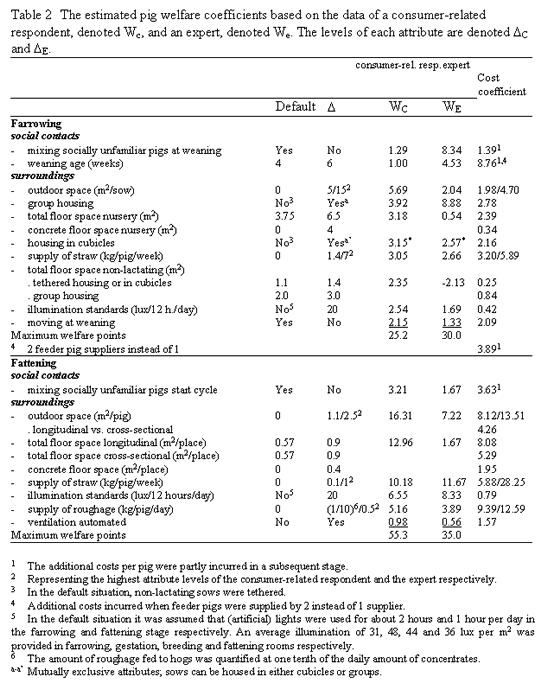
The attributes presented in Table 2 are in order of decreasing chain pig welfare coefficients of the consumer-related respondent. The values of attribute levels that were quantified in open?end questions are also shown. In correspondence to the general perception (Table 1), both the consumer-related respondent and the expert regarded the fattening stage as most important with respect to the overall welfare of the pigs.
Both respondents favored especially the surroundings related attributes in this stage. On a scale from 0 to 100, the absolute total scores varied considerably, however (55.3 versus 35 respectively (Table 2)).
Individual differences concerned particularly the access to outdoor space. The consumer-related respondent appreciated this attribute more than the expert, who assigned, moreover, a lower pig welfare coefficient to a bigger amount of outdoor space per animal. The same contrast was shown for outdoor space in the farrowing case. Additionally, the consumer-related respondent considered an increase of the resting period from 2 to 4 hours non-beneficial to the welfare of the pigs, as can be seen from the negative coefficient in Table 2. Similar to the general perception, both the consumer-related respondent and the expert considered the social contacts related attributes the most important pig welfare ones in the transportation and slaughtering stages.
Table 2 The estimated pig welfare coefficients based on the data of a consumer-related respondent, denoted Wc, and an expert, denoted We. The levels of each attribute are denoted ΔC and ΔE.
Table 2 Continued.
3.2 Static linear programming approach
The least-cost chain concepts of the static linear programming approach for different desirable levels of additional pig welfare are presented in Table 3 (placed at the end of the paper). Results are shown for additional pig welfare (Wtot) levels of 10, 20, 30, 50, 70 and the maximum level of 100 points. The total additional costs incurred are expressed per pig from farrowing to slaughtering. When an improvement in additional pig welfare (Wtot) of at least 10 points was required, the coefficients of the consumer-related respondent resulted in an optimal chain concept incurring Dfl. 0.19 higher costs per pig (Table 3) than in the default situation, i.e. Dfl. 357 per pig from the farrowing to the slaughtering stage. Seven attributes were incorporated into this optimal concept ranging from 'not keeping pigs at the slaughterhouse overnight', 'reducing the stock density in the slaughterhouse lairage rooms from 300 to 235 kilograms of live weight per m2' to 'increasing concrete floor space in nursery pens by 1.35 m2' (Table 3). Increasing the Wtot constraint to higher levels, both values of some already included attributes were enhanced and new attributes were added.
The relatively low additional pig welfare levels were satisfied at lower additional costs per pig (Table 3) when using the coefficients of the expert. At a Wtot-level of 10 even a net benefit of Dfl 0.05 per pig was found. The money saved from not having to pay the compensation for pigs that stay at the slaughterhouse overnight, was the main reason for this net benefit. In the case of the expert, higher pig welfare coefficients were attached to attributes with relatively lower cost coefficients. Examples involve the attributes 'stock density' in the slaughterhouse and 'handling' during transportation. As a result, it can be seen from Table 3 that when using the coefficients of the expert fewer attributes were needed to achieve the same level of additional pig welfare. However, the attributes that were incorporated were almost identical. Until a Wtot level of 30, the optimal chain concepts based on the expert only differ with respect to the length of the resting period prior to slaughter. As the consumer-related respondent considered an increase in this attribute not beneficial to the pigs' welfare (Table 2), this attribute was not included in the corresponding least-cost chain concepts at all (Table 3). The same holds for the increase in total floor space of non-lactating sows with respect to the expert. From a Wtot level of 50 points and higher, the difference in attributes included in the optimal chain concepts increased. Compared with the consumer-related respondent, particularly attributes related to the farrowing stage were included earlier. Examples involve 'not mixing unfamiliar pigs at weaning', 'not moving piglets at weaning' and 'supply of straw to sows'. On the other hand, attributes such as 'access to outdoor space' and 'increasing total and concrete floor space' were added later. The consumer-related respondent attached more value to an increase in (concrete) floor space for improving the pigs' welfare than the expert did. As a result, the attribute 'increasing total floor space in the nursery pen', for example, was added to the optimal chain concept at a Wtot level of only 10 in the case of the consumer-related respondent versus a level of 70 in the case of the expert.
3.3 Dynamic linear programming approach
When comparing the values of the attributes of the optimal chain concepts at the various Wtot levels in Table 3, it can be seen that some attributes decreased or were excluded from the chain concept at a higher Wtot level. Examples are the concrete floor space of the nursery pen (Wtot level of 10 versus 20 points) in the case of the consumer-related respondent (Table 3), and the increase of the resting period (10 versus 20 and 30 versus 50 points), water spraying prior to slaughter and raising the illumination standards in the farrowing stage (30 versus 50 points) in the case of the expert (Table 3). As mentioned before, this was the main reason for switching from the static to the dynamic linear programming approach.
Results of the dynamic linear programming approach are shown for a three-step improvement in additional pig welfare (Wtot) (Table 4; placed at the end of the paper). Included are the Wtot levels at which attributes were excluded or decreased in value when using the static approach. For reasons of comparison, the total additional costs per pig rather than the discounted costs are presented.
When comparing the results of the dynamic approach (Table 4) with those of the static linear programming one (Table 3) it can be seen that indeed no attributes were excluded or decreased in value at increasing levels of Wtot. In the case of the consumer-related respondent's results, the concrete floor space in the nursery pen increased at a Wtot level of 10 as well as at 20 points. As a result of the smaller increase in concrete floor space at a Wtot level of 10 points, the attributes 'water spraying', 'automated lifting platforms' and 'automated ventilation' were no longer sufficient to satisfy the constraint of a Wtot level of 10 points. Instead, these attributes entered the optimal chain concept only at a Wtot level of 20 points. On the other hand, the illumination standards at the farrowing stage had already been raised at a Wtot level of 10 points. The attributes incorporated at the Wtot level desired in the final period influenced the optimal solutions at lower Wtot levels. As a result, as expected, the additional costs incurred at lower Wtot levels were higher in the dynamic approach than in the static one.
In the case of the expert's results, the attributes 'water spraying' and 'automated lifting platforms' at the slaughterhouse changed places as to their position at the Wtot level of 20 points. This resulted from the longer resting period which was also present at a Wtot of 20 points (dynamic approach). Moreover, the length of the resting period was reduced at the Wtot level of 30 and increased at the Wtot level of 50 in order to realize a gradual improvement (dynamic approach). Because the length of the resting period decreased and illumination standards were no longer raised at a Wtot level of 30, a further decrease of the stock density during transportation and not mixing unfamiliar pigs during transportation and resting, resulted in the least-cost additional welfare points required.
4 DISCUSSION AND CONCLUSIONS
Using a chain model instead of separate stage simulation models offers the advantage of taking interstage relations into account. Interstage relations were quantified for both economic effects and pig welfare concerns. The contributions of the various concerns on the welfare of pigs along the stages of the pork chain were quantified, using a questionnaire developed and analysed by conjoint analysis of multi-attribute parameters.
Conjoint analysis is especially suitable for handling variables that are qualitatively specified or evaluated on different scales. This was especially suitable as the pig welfare predictor variables included both nominal and ratio scaled attributes and, as pig welfare, as a response variable, seems a qualitative notion itself. Moreover, with respect to product development it is the consumer's perception of pig welfare that is also (i.e. more) important (Sybesma, 1981), being a nonmetric and personal notion in itself. Potentially, consumer's perception could even be in conflict with scientific indicator criteria or expert perceptions based on these criteria (Kramer, 1990). Based on the valid and useful results obtained, this method seems to be a promising tool for broader application in livestock farming research. Examples may range from evaluation of exterior characteristics of livestock to the assessment of the relative importance of qualitative factors e.g. in disease control or animal replacement decisions.
In general, the predictive validity of the estimated models was good, indicating that the respondents were quite capable of a consistent evaluation of the pig welfare attributes. On average, Pearson's and Kendall's correlation coefficients equalled 0.92 and 0.78 respectively. Differences in validity observed between respondents could partly have resulted from different perceptions of attribute interactions. The expected attribute interactions that were incorporated in the questionnaire were not always mentioned in the open?end questions on potential interactions. Moreover, respondents mentioned interactions not included in the questionnaire or interactions with attributes that were not included either. Although the attributes and attribute levels incorporated in the models have been carefully selected, there will be attributes excluded that affect both the welfare of the pigs and the behaviour of people in response thereof in the marketplace (Cattin and Wittink, 1982).
Static and dynamic linear programming models were developed in order to explore the potential effects of incorporating various pig welfare-related attributes into the structure and economics of the production and transportation stages of the pork chain. Although the pig welfare coefficients of the consumer-related respondent and the expert were not similar, and can only be perceived as individual perceptions, the sequence in which the various attributes entered into the chain concepts showed great resemblance. Until a Wtot level of 20 points (consumer-related respondent) and 30 points (expert), the same 9 out of 10 attributes were included in the least-cost chain concepts. These attributes involved transportation- and slaughterhouse-related attributes in particular, including 'reducing stock densities', 'water spraying in lairage rooms', 'using automated lifting platforms for unloading pigs at the slaughterhouse', and 'handling the pigs quietly without the use of electric prodders'. Moreover, illumination standards were raised in both the farrowing and the fattening stage. These attributes also proved to be quite stable in sensitivity analyses. The additional costs incurred varied between Dfl. 0.56 and Dfl. 1.20 per pig depending on the pig welfare perceptions of the respondent that were used as input.
Table 3 Results static linear programming approach: least-cost (Dfl./head) pork chain concepts at different desirable additional pig welfare levels, using the coefficients of a consumer-related respondent and an expert.
Table 4 Results of the dynamic linear programming approach: least-cost (Dfl./head) pork chain concepts for a desirable additional pig welfare level of 50 points in three successive steps of 10, 20 and 30 points, using the coefficients of the consumer-related respondent and the expert.
REFERENCES
Anonymous (1991) Richtlijnen voor de produktie, verwerking en handel in I.S.C.-scharrelvarkensvlees. Internationale Scharrelvarkensvlees Controle (I.S.C.), Utrecht, [in Dutch].
Anonymous (1994) What's in a name? Feiten and fabels over vleesmerken. Stichting 'Lekker Dier', Utrecht, [In Dutch].
Bäckström L (1973) Environment and animal health in piglet production: a field study of incidences and correlations. Acta Veterinaria Scandinavia suppl. 41: 1-240.
Cattin P, Wittink DR (1982) Commercial Use of Conjoint Analysis: a survey. Journal of Marketing 46: 44-53.
Den Ouden (1996) Economic modelling to study vertical cooperation in animal production-marketing chains. PhD-Thesis, Wageningen University, Farm Management Group, Wageningen, The Netherlands.
Fraser AF, Broom DM (1990) Farm animal behaviour and welfare. Bailliere Tindall, London.
Gloor P (1988) Die Beurteilung der Brustgurtanbindehaltung für leere und tragende Sauen auf ihre Tiergerechtheit unter Verwendung der "Methode Ekesbo" sowie ethologischer Parameter. Eidg. Forschungsanstalt für Betriebswirtschaft und Landtechnik, Tänikon.
Grandin T (1980) Livestock behaviour as related to handling facilities design. International Journal Stud. Anim. Prob. 1 (1): 33-52.
Green PE, Srinivasan V (1978) Conjoint analysis in consumer research: issues and outlook. Journal of Consumer Research 5: 103-121.
Hair JF, Anderson RE, Tatham RL (1990) Multivariate data analysis: with readings. 2nd edition. Macmillan Publishing Company, New York, 407-428.
Huber J, Wittink DR, Fiedler JH, Miller R (1993) The effectiveness of alternative elicitation procedures in predicting choice. Journal of Marketing Research 30: 105-114.
Kramer CS (1990) Food Safety: the consumer side of the environmental issue. S. Journal of Agricultural Economics 22: 33-46.
Siegel S (1956) Nonparametric Statistics for the behavioral sciences. McGraw-Hill Book Company Inc., New York.
Steenkamp JEBM (1985) De constructie van profielensets voor het schatten van hoofdeffecten en interacties bij conjunct meten. Jaarboek van de Nederlandse Vereniging van Marktonderzoekers. Haarlem: De Vrieseborch, 125-154 [In Dutch].
Steenkamp JEBM (1987) Conjoint measurement in ham quality evaluation. Journal of Agricultural Economics 38: 473-480.
Sybesma W (Ed.) (1981) The welfare of pigs. A seminar in the E.E.C. Programme of coordination of research on animal welfare held in Brussels, November 25-26, 1980. Martinus Nijhoff Publishers, The Hague.
Van Putten G, Elshof WJ (1978) Observations on the effect of transport on the well-being and lean quality of slaughter pigs. Animal Regulation Studies 1: 247-271.
Vellenga L, van Veen HM, Hoogerbrugge A (1983). Mortality, morbidity and external injuries in piglets housed in two different housing systems. I. Farrowing house. The Veterinary Quarterly 5 (3): 101-106.
|