|
Welfare assessment and of on-farm animal welfare index systems
The welfare, health and management of farm animals are relevant issues that have an impact on the success of the producer in the market and need to be considered in order to increase consumer acceptance of animal production in the near future. Criteria for the assessment of farm animal housing have been proposed by several groups and minimal standards for animal welfare are already implemented in the legislation of most European countries (as reviewed by von Borell, 1996). These minimal requirements implemented by legislation do not relate to all farm animal species or production stages. For example, there is no specific EU council directive on the minimal housing requirements for dairy and beef cattle.
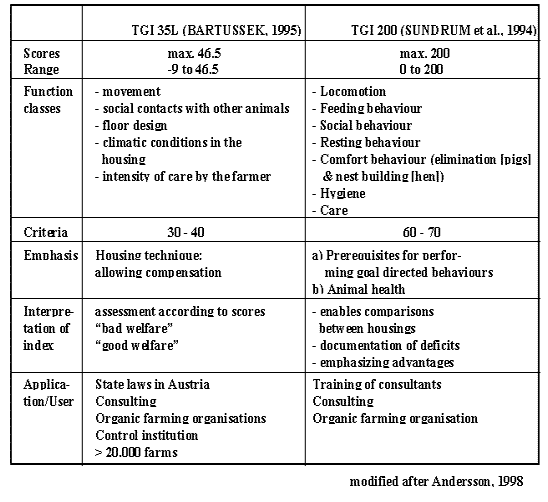
In order to assess animal welfare on the farm in a variety of production systems, different assessment systems have been developed in Europe, considering the advantages and disadvantages of specific housing and management features for the welfare of farm animals. The idea for creating an index system for welfare assessment goes back to a concept of Bartussek (1985), proposing a Tier-Gerechtheits-Index (TGI, translated as animal needs index) in context with a state directive for intensive animal housing legislation in Austria. The concept has been further developed leading to the current version which is called TGI 35 L, with an index system for cattle, laying hens and fattening pigs (Bartussek, 1995 a,b,c). On-farm evaluation is based on an assessment sheet on which a range of scores is assigned to a variety of housing features, technical prerequisites and management measures for different functional areas in the housing environment that have an impact on the health and welfare of farm animals. The TGI 35 L is mainly based on technical requirements in the housing system (i.e. space allowance and floor quality), considering 30-40 criteria. Initially, one to seven points were assigned to each of 5 functional areas of the housing environment summing up to 35 points as the highest score. More recent versions are allowing a more differentiated scoring, including a negative score or higher scores than initially proposed (see Tab. 1). It also considers that animals can compensate for negative influences in one aspect by positive in another.
Based on the TGI concept of BARTUSSEK, another assessment system was developed by Sundrum et al. (1994) as a contribution for a state competition, providing a guideline for animal welfare friendly housing of laying hens, calves and pigs. This concept includes 60-70 criteria that are assessed for 7 functional classes with emphasis on prerequisites for the performance of goal directed behaviours and factors that have an impact on animal health. A maximum of 200 points can be assigned, ranging from 0 to 200 (see Tab. 1). This concept allows a repeated scoring of special housing features in multiple categories, which partly explains the relative high scores. Intensive housing systems such as housing of fattening pigs in indoor pens on slatted floors can therefore never exceed a certain score (in this example about 120 points), even when aspects like health and care are optimal.
Tab.1: Differences between TGI 35 L and TGI 200
Evaluation of on-farm animal welfare index systems
This evaluation is intended to summarise some of the major advantages and disadvantages of on-farm index systems in general rather than comparing the two index systems TGI 35 L and TGI 200 in terms of reliability and practicability. The latter would require a very detailed comparison within functional classes of each system, which has been already done by Van den Weghe (1998) and others (Ofner et al., 2000; Hörning, 2000).
Advantages:
1. On-farm animal welfare indexing constitutes a practical method to assess major deficits in a housing system within a relatively short period of time (approx. one hour).
2. The TGI evaluates welfare relevant criteria for different functional aspects of the housing environment and on the animal itself in a very systematic way.
3. The assessment requires a relative short training of the assessors, although this training is very critical for reliability of the assessment.
4. Repeatability of scores between different assessors and for multiple visits on the same farm is relatively high for objectively measured criteria (i.e., for pen dimensions).
Disadvantages:
1. The on-farm indexing system contains subjectively scored criteria such as cleanliness and the quality of flooring (i.e., decision whether floor is slippery or non-slippery).
2. The time point of the farm visit for assessment is critical. The situation during summer might be different from that during winter. Outdoor systems are significantly influenced by the actual climatic condition.
3. The evaluation sheet contains some uncertainties concerning some of the definitions, interpretations and explanations. For example, the welfare relevance of dehorned versus horned cattle in mixed herds with both types of cattle.
4. A conclusive statement for a particular housing system such as "good" or "bad" in terms of welfare is not appropriate as this method of assessment is not based on scientific grounds. Especially the weighting of the different criteria for welfare relevance is critical.
Tab. 2: Specific welfare assessment criteria for pigs (Knierim et al., 2000)
Testing of serious produced farm animal housing equipment or systems
Pre-testing of housing equipment or systems has been discussed within Europe for a long time. Switzerland, Sweden and Norway have already implemented mandatory systems for approval of new technology. Switzerland is most advanced in that regard, as new technology has to be tested mainly on a specific federal testing station or on reference farms by means of ethological studies and veterinary assessment (Troxler, 1998). The Scandinavian approach (Sweden and Norway) is to assess animal housing mainly based on epidemiological field studies using clinical, subclinical and behavioural records (Ekesbo, 1992). The Animal Welfare Committee of the German Agricultural Society (DLG) has now established a procedure of voluntary assessment and certification of housing and handling equipment according to welfare criteria within the utility value testing system (Hesse et al.., 1999). A legal frame for such a testing is given by the German Animal Welfare Act of 1998 (Knierim et al., 2000a). Welfare assessment is mainly based on functional classes of behaviours which are relevant for the specific equipment being tested (see example for functional classes and criteria on pig welfare assessment in Tab. 2; Knierim et al., 2000b). If relevant, other criteria such as physiological, pathological, performance and hygiene are added to the testing procedure. Testing is conducted on research stations or reference farms under the control of testing engineers being advised on the welfare assessment protocol by experts of the Welfare Committee. A certificate (DLG tested) is only provided if the new technology complies with the existing welfare standards.
Evaluation of testing concepts for serious produced farm animal housing equipment
The following general evaluation summarises the advantages and disadvantages of housing equipment testing, although there might be some distinct differences in some aspects between the existing testing concepts.
Advantages:
1. Data collection and documentation is based on scientific principles in terms of numbers of animals and replications.
2. Unsuitable housing features are excluded from certification or being improved during the procedure to meet the standards.
3. Inclusion of welfare assessment criteria in the testing of animal housing will stimulate the development of new welfare friendly technology.
4. The certificate (i.e., DLG tested) will help the producer to gain acceptance and to be able to compete on the market.
Disadvantages:
1. The testing procedure is relatively time consuming and expensive.
2. The level of bureaucracy is relatively high, especially for federally supervised compulsory testing.
3. Compulsory testing requirements in some countries might hamper free trade in the European Union.
4. The testing results (if mainly collected from research stations) might not entirely reflect the on-farm situation, as deficiencies in management and complex interactions between animals, technology and the whole housing system are usually excluded from assessment.
Hazard Analysis and Critical Control Point (HACCP) system
HACCP was originally developed as a microbiological safety system to ensure the safety of food. It was based on the engineering system, Failure, Mode and Effect Analysis (FMEA), which looks at what could potentially go wrong at each stage in an operation together with possible causes and the likely effect (Mortimore and Wallace, 1998). Effective control mechanisms are then put in place to ensure that the potential failures are prevented from occurring. HACCP looks for hazards in the product-safety sense and became eventually a legislative requirement for food safety and food hygiene in many countries. The principles of the HACCP concept have been extended to animal health management strategies by various groups, demonstrating that process control (expressed in terms of controlling both general and specific disease risk factors) and product control (expressed in terms of testing animals or animal products for specific disease agents) could form the basis for improving animal health. More recently, this concept has been adopted by welfare scientists in order to safeguard the welfare of farm animals (Grandin, 2000a,b). An animal welfare index is currently developed in The Netherlands that might become an integrated part of the Dutch Integrated Quality Control (IKB) program which is based on elements of the quality assurance system ISO-9000 (Vesseur and Den Hartog, 2000). A major component of the HACCP system is to describe potential hazards and to establish Critical Control Points (CCP) to assuring the safety of the product (or in relation to welfare assessment: to safeguard the welfare of the animal in the production process). The critical limits for each identified CCP must involve a measurable parameter. The working group "Animal Husbandry and Animal Welfare" of the German Association for Animal Production (DGfZ) is currently establishing assessment criteria for housing and management practices being mainly based on sound scientific knowledge from the literature, ensuring that the necessary parameters can be objectively measured and verified (von Borell, 2000). A number of prerequisites or minimal requirements are already given by existing technical standards, legislation or are simply based on Good Farming Practice. The actual critical limits are not necessarily based on scientific principles as there are no clear cut thresholds between "good" and "bad" welfare. Grandin (2000a) recently developed an animal welfare audit for cattle and pig slaughterhouses that includes control points such as stunning efficacy, animal vocalisation scores and electric prod usage. A large food company (McDonald's Corporation) has now added animal handling and stunning audits to their existing food safety audits being assessed by a third party HACCP team. Currently, this company has established an animal welfare committee that sets minimum housing and management requirements for egg suppliers (i.e., for minimal space allowance in cages). There are numerous other programs driven by supermarkets, consumer and welfare organisations, having all set up their own welfare standards to satisfy the specific demand for niches in the marketplace.
Evaluation of the HACCP concept for welfare, health and management criteria
The following evaluation strictly relates to the advantages and disadvantages of the HACCP concept applied to criteria and critical limits for farm animal welfare, health and management:
Advantages:
1. The assessment/auditing is under third party control with independent inspectors/auditors being member of the HACCP team
2. A high repeatability between assessors is guaranteed
3. The critical limits for each of the Critical Control Points are generated by objective measurements on a regular basis.
4. The critical limits are clearly defined within the specific program.
Disadvantages:
1. Only few criteria might fulfill HACCP requirements. Others with relevance for animal welfare, health and management may not be accessible by the HACCP protocol (i.e., incidence of behavioural deviations).
2. The specific time point of assessment is critical (the same as for TGI assessment).
3. The certification might suggest a uniform internationally accepted standard for welfare, health and management assessment. In reality, the critical limits and certification process might vary considerably between the specific programs.
4. The critical limits might not be based on scientific knowledge.
Conclusions and future outlook
Low investment costs and high production efficiency are vital criteria for future competitiveness in animal production. However, in contrast to the past decades, issues such as animal welfare and health, environmental care, product safety and consumer acceptance are becoming increasingly important and need to be strongly considered in future livestock housing assessment. All concepts of animal welfare indexing may eventually improve the welfare of farm animals in the long run, considering that all programs have their advantages and disadvantages and depending on the specific goals for which they were introduced. On-farm assessment of welfare has to be combined with the current scientific knowledge on how animals perceive their social and technical environment. Fundamental studies from different scientific disciplines (i.e., psychophysiology, pathology and stress physiology) can help to create better assessment parameters and to improve the interpretation of what we can observe on the farm. Animal welfare has become now an integrated part of quality assurance programs for sustainable animal production, considering that welfare, health, management, economy, consumer acceptance and environmental impact are depending on each other (see Fig. 1). For this purpose, welfare assessment via objectively measured indicators provide the knowledge needed to further improve this approach in the future.
Fig. 1: Factors influencing livestock housing assessment
References
Andersson R (1998) Der Tiergerechtheitsindex - TGI. In: Beurteilung der Tiergerechtheit von Haltungssystemen. KTBL-Schrift 377, Münster-Hiltrup, Germany, pp 99-109.
Bartussek H (1985) Vorschlag für eine Verordnung der Steiermärkischen Landesregierung für den Bereich der Intensivtierhaltung. Der österreichische Freiberufstierarzt 97/1985, 4-15.
Bartussek H (1995a) Animal needs index for cattle, TGI 35 L, March 1995. Federal Research Centre for Alpine Agriculture, Gumpenstein, Austria.
Bartussek H (1995b) Animal needs index for laying hens, TGI 35 L, November 1995. Federal Research Centre for Alpine Agriculture, Gumpenstein, Austria.
Bartussek H (1995c) Animal needs index for fattening pigs, December 1995. Federal Research Centre for Alpine Agriculture, Gumpenstein, Austria.
von Borell E (1996) Current situation on welfare legislation and research within the European Union, Review Article, Pig News Inf. 17, 105N-107N.
von Borell E (2000) Assessment of pig housing based on the HACCP concept - critical control points for welfare, health and management. In: Blokhuis, H.J., Ekkel, E.D. and Wechsler, B. (editors): Improving Health and Welfare in Animal Production, EAAP publication No. 102, Wageningen Pers, The Netherlands, pp 75-80.
Ekesbo I (1992) Monitoring systems using clinical, subclinical and behavioural records for improving health and welfare. In: Moss, R. (editor): Livestock Health and Welfare, Longman Scientific, Harlow, UK, pp 20-50.
Grandin T (2000a) 1999 audits of stunning and handling in federally inspected beef and pork plants. 2000 Conference on Animal Handling and Stunning, Kansas City MO, USA, pp 1-22.
Grandin T (2000b) Effect of animal welfare audits of slaughter plants by a major fast food company on cattle handling and stunning practices. JAVMA 216: 848-851.
Hesse D, Knierim U, von Borell E, Herrmann H-J, Koch L, Müller C, Rauch H-W, Sachser N, Schwabenbauer K, Zerbe F (1999) Freiwilliges Prüfverfahren für Stalleinrichtungen entsprechend dem novellierten Tierschutzgesetz von 1998. Dtsch. tierärztl. Wschr. 106: 138-141.
Hörning B (2000) Scoring systems to assess housing conditions of farm animals - examples from dairy cows and laying hens. In: Blokhuis, H.J., Ekkel, E.D. and Wechsler, B. (editors): Improving Health and Welfare in Animal Production, EAAP publication No. 102, Wageningen Pers, The Netherlands, pp 89-97.
Knierim U, Hesse D, von Borell E, Herrmann H-J, Koch L, Müller C, Rauch H-W, Sachser N, Zerbe F (2000a) Anforderungen an freiwillige Prüfverfahren gemäß ï¿½ 13a Tierschutzgesetz. DLG-Merkblatt, Frankfurt (in press).
Knierim U, von Borell E, Herrmann H-J, Koch L, Müller C, Rauch H-W, Sachser N, Zerbe F, Hesse D (2000b) Minimum standards for voluntary animal welfare assessment procedures concerning series produced farm housing equipment. Anim. Welfare (submitted).
Mortimore S, Wallace C (editors), (1998) HACCP - A practical approach. Second edition, Aspen Publishers, Inc., Gaithersburg, Maryland, USA, pp 1-403.
Ofner E, Amon B, Amon Th, Boxberger J (2000) Validation of the "TGI 35 L 1995/96" Austrian Animal Needs Index. In: Blokhuis, H.J., Ekkel, E.D. and Wechsler, B. (editors): Improving Health and Welfare in Animal Production, EAAP publication No. 102, Wageningen Pers, The Netherlands, pp 81-87.
Sundrum A, Andersson R, Postler G (1994) Animal needs index 200 - a guide for the assessment of housing systems, Köllen-Verlag, Bonn, Germany.
Troxler J (1998) Angewandte Prüfungsmethoden. In: Beurteilung der Tiergerechtheit von Haltungssystemen. KTBL-Schrift 377, Münster-Hiltrup, Germany, pp 51-54.
Van den Weghe S (1998) In: Beurteilung der Tiergerechtheit von Haltungssystemen. KTBL Schrift 377, Münster-Hiltrup, Germany, pp 110-119.
Vesseur PC, Den Hartog LA (2000) Integrated quality management - the base of future pig production. Arch. Tierz., Dummerstorf 43, Sonderheft, 116-123.
|