|
ABSTRACT
European consumers are becoming increasingly critical as
far as food is concerned with safety and animal welfare. They
want to know more about breeding methods, fattening procedures
and animal husbandry, prevention and eradication of severe animal
diseases and meat inspection. At the same time the image and reliability
of the quality of meat is becoming more disputable in the eye of the consumer.
Both trends urge the necessity of quality assurance and quality management
programmes in the process of food pro-duction to preserve consumer acceptance.
Given the decline in consumer confidence in meat, one of the main aims of consumer
protection is to ensure that "safe products" are put onto the market.
Modern control systems in the production of food of animal origin include
the entire food chain, shift the control focus from the final product to
process and system monitoring, demand increased self-responsibility through
the establishment of self-assessment measures and assign new tasks to food control.
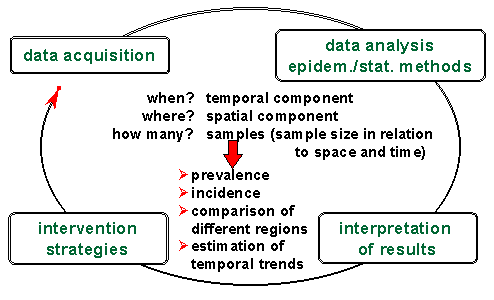
Figure 1: Biometrical control systems
|
Control systems are based on a cycle mechanism, starting from data acquisition
and data analysis using appropriate analytical and epidemiological/statistical
methods, ranging to the interpretation of results, feedback to the persons in
charge of intervention strategies and finally to the intervention program itself,
which in its turn directly influences the sampling system. Data acquisition usually
requires the sample size and corresponding sample design
(e.g. simple random sample, PPS method etc.) to be tailored
to the aim of the respective programme (estimated prevalence and
incidence, comparison of different regions, or estimation of temporal trends).
In the case of spatial/temporal interactions the sample design must always take
the following components into account: "when" (temporal component) and "where"
(spatial component) must "how many" samples (sample size in relation to space
and time) be taken. Practical examples of process control (slaughtering), the
implementation of monitoring programs (animal health) and of surveillance programs
(Salmonella in pork) will be presented.
|